
What Is GSM in Paper? The Complete Guide to Paper Weight, Thickness & Choosing the Right Stock
If you've ever bought paper and been confused by numbers like 80 GSM, 170 GSM, or 350 GSM, you're not alone. GSM is the universal measurement for paper weight, and understanding it is the single most useful thing you can learn before buying paper or ordering a print job. This guide explains what GSM means in plain language, how it relates to paper thickness, and exactly which GSM you need for every common project.
What Is GSM?
GSM stands for grams per square metre. It tells you how much a single sheet of paper would weigh if it were exactly one square metre in size. The higher the GSM number, the heavier and (generally) thicker the paper.
It's the standard unit used by paper manufacturers, print shops, and stationery suppliers worldwide. You'll see it written as “80 gsm,” “80 g/m²,” or simply “80g.” They all mean the same thing.
Think of it like a density measurement for paper. A sheet of standard office paper (the kind you load into your printer) is 80 GSM. A business card is around 350 GSM. A newspaper is about 45 GSM. The bigger the number, the more substantial the paper feels in your hand.
The Simple Rule
Low GSM (35–90): thin, lightweight, flexible. Good for everyday printing and reading.
Medium GSM (100–200): sturdy, quality feel. Good for brochures, flyers, and premium stationery.
High GSM (200–400+): thick, rigid, card-like. Good for business cards, postcards, and packaging.
GSM vs Thickness: What's the Difference?
This is one of the most common points of confusion. GSM measures weight, not thickness. While heavier paper is usually thicker, the two are not always directly proportional.
Paper thickness is measured in microns (µm) or thousandths of an inch (mils/points). Two sheets with the same GSM can have different thicknesses depending on:
- How compressed the fibres are: tightly pressed paper is thinner but weighs the same
- The type of coating: coated papers are denser, so a coated 200 GSM sheet will feel thinner than an uncoated 200 GSM sheet
- The raw material: cotton-based paper is loftier (thicker) than wood-pulp paper at the same GSM
- Air content: some papers are “bulky” with more air between fibres, making them thicker without being heavier
This is why a 300 GSM uncoated business card can feel thicker and more textured than a 350 GSM coated one. When choosing paper, GSM gives you the weight, but if thickness matters for your project (for example, meeting postal requirements for postcards), check the micron or caliper measurement too.
Common GSM Ranges and Their Uses
The table below covers the full spectrum of paper weights you'll encounter, from tissue-thin newsprint to heavy packaging board. Use it as a quick reference when choosing paper for any project.
| GSM Range | Category | How It Feels | Common Uses |
|---|---|---|---|
| 35–55 | Newspaper, tissue paper | Very thin, semi-transparent | Newspapers, bible pages, tracing paper |
| 70–90 | Standard office paper | Light, flexible | Printer paper, copy paper, notepads |
| 90–120 | Premium stationery | Sturdy, quality feel | Letterheads, quality writing paper, forms |
| 120–170 | Flyers and leaflets | Firm, holds shape | Flyers, brochures, magazine pages |
| 170–200 | Heavy brochures, covers | Thick, substantial | Magazine covers, promotional material |
| 200–300 | Light cardstock | Stiff, can stand upright | Postcards, greeting cards, folders |
| 300–400 | Heavy cardstock | Rigid, professional | Business cards, book covers, invitations |
| 400+ | Board and packaging | Very rigid, board-like | Luxury packaging, mounting board, box covers |
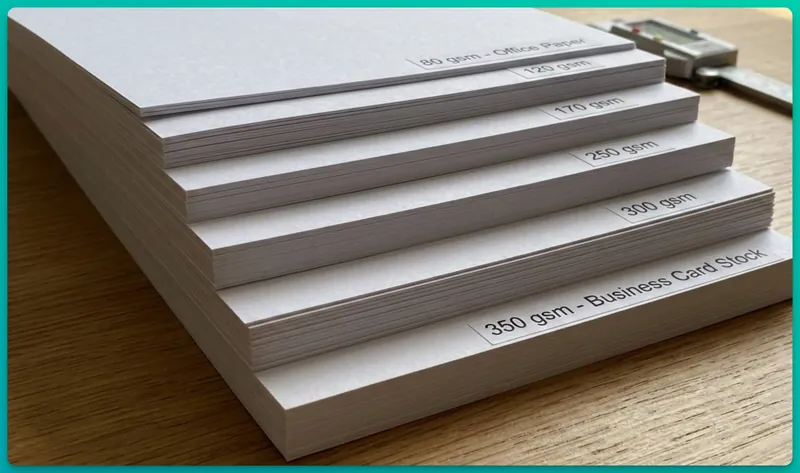
Most people interact with paper in the 75–120 GSM range daily (office paper, notebooks, letters). Once you go above 200 GSM, the paper starts to feel more like card, which is exactly why cardstock for business cards and postcards sits in the 300–400 GSM range.
Paper vs Card: Where's the Line?
There's no official rule, but the industry generally draws the line around 200–250 GSM:
- Paper: up to about 170 GSM. Flexible, can be folded easily, rolls without cracking.
- Lightweight card: 170–250 GSM. Can hold its shape upright but still bends without snapping.
- Cardstock / heavy card: 250 GSM and above. Rigid, needs scoring before folding, used for business cards, covers, and packaging.
This matters when you're ordering prints from a shop. If you ask for “paper” and you actually need rigid business cards, you could end up with flimsy flyer stock. Always specify the GSM rather than just saying “paper” or “card.”
Coated vs Uncoated Paper
Beyond GSM, the biggest factor that affects how your paper looks, feels, and prints is whether it's coated or uncoated. This distinction applies at every GSM level.
Coated Paper
Coated paper has a thin layer of clay, calcium carbonate, or polymer applied to one or both sides. This coating fills in the microscopic gaps between paper fibres, creating a smoother, more uniform surface.
- Better colour reproduction: ink sits on top of the coating rather than soaking into the fibres, producing sharper images and more vivid colours
- Smoother surface: ideal for photographs, detailed graphics, and full-colour printing
- Less ink absorption: uses less ink overall, which can reduce printing costs on large runs
- Feels thinner: at the same GSM, coated paper feels thinner and denser than uncoated paper because the fibres are compressed
Coated paper comes in several finishes: gloss (shiny, reflective), silk/satin (smooth with a subtle sheen), and matte coated (smooth but non-reflective).
Uncoated Paper
Uncoated paper has no surface coating. The fibres are exposed, giving it a more natural, textured feel.
- Easy to write on: pen and pencil grip the surface well; coated paper can be slippery
- Warmer, more natural feel: often preferred for stationery, letterheads, and premium invitations
- More ink absorption: colours can appear slightly muted compared to coated paper
- Feels thicker: at the same GSM, uncoated paper has more “bulk,” so it feels thicker in your hand
Uncoated paper includes everyday copy paper, bond paper, laid paper (with textured lines), and wove paper (smooth but uncoated). Premium uncoated stocks like cotton rag are used for wedding invitations, letterpress printing, and fine art.
Coated vs Uncoated: Quick Comparison
| Feature | Coated | Uncoated |
|---|---|---|
| Surface | Smooth, sealed | Textured, natural |
| Colour vibrancy | High, vivid, saturated | Softer, slightly muted |
| Writability | Poor, ink can smear | Excellent |
| Perceived thickness | Thinner at same GSM | Thicker at same GSM |
| Best for | Photos, brochures, flyers | Letters, invitations, notebooks |
| Cost | Higher | Lower (usually) |
Matte vs Gloss: How Finish Affects Your Print
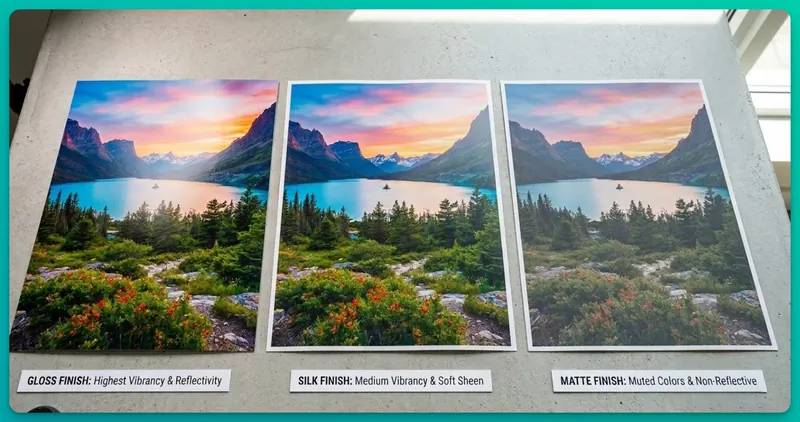
If you choose coated paper, you'll need to pick a finish. The three main options are gloss, silk (satin), and matte. Each handles ink and light differently.
Gloss
Gloss paper has a shiny, reflective surface. It makes colours pop and images look sharp. Think magazine covers and product brochures. The downside is glare: glossy prints can be hard to read under bright lights, and fingerprints show easily. Gloss is the best choice for photo-heavy designs where you want maximum colour impact.
Silk / Satin
Silk (also called satin) offers a middle ground: a smooth surface with a soft, non-reflective sheen. It's the most popular finish for professional brochures and flyers because it gives excellent colour reproduction without the glare of gloss. Text is easier to read on silk than on gloss, making it versatile for designs that mix large images with body text.
Matte
Matte coated paper has no shine at all. It gives a sophisticated, understated look and is the easiest coated surface to read text on. Colours are slightly less vivid than gloss but still sharper than uncoated paper. Matte is popular for art prints, portfolios, and premium stationery where elegance matters more than colour punch.
How to Choose the Right GSM for Your Project
Choosing the right GSM comes down to three questions:
- What is the purpose? Something handed out on the street (flyer) needs to be lighter than something kept on a desk (business card).
- Is it single or double-sided? Double-sided printing needs at least 120 GSM to prevent show-through (where you can see the printing on the other side).
- What impression do you want to make? Heavier paper feels more premium and professional. If you're printing a portfolio, résumé, or wedding invitation, the weight of the paper communicates quality before anyone reads a word.
The table below gives specific GSM recommendations for every common print project, along with the best paper type and practical notes.
| Project | GSM | Paper Type | Notes |
|---|---|---|---|
| Everyday printing & drafts | 75–80 | Standard uncoated | Cheapest option; fine for internal documents |
| Professional letters & CVs | 100–120 | Premium uncoated or laid | Noticeable quality upgrade over standard 80 GSM |
| Flyers (handouts) | 130–170 | Coated gloss or silk | Light enough to hand out; vibrant print |
| Brochures (folded) | 150–200 | Coated silk or matte | Heavy enough to hold a fold without creasing |
| Posters | 170–250 | Coated gloss or matte | Larger sizes need higher GSM to avoid curling |
| Postcards | 250–350 | Coated or uncoated card | Must meet postal thickness requirements |
| Business cards | 300–400 | Coated or uncoated card | 350 GSM is the industry standard |
| Wedding invitations | 270–350 | Cotton, laid, or textured | Uncoated gives a luxury feel; often letterpress |
| Book covers (softcover) | 250–350 | Coated card with lamination | Lamination adds durability and sheen |
| Photo prints | 200–300 | Glossy or satin photo paper | 260 GSM is the sweet spot for home printing |
| Art prints & giclée | 250–350 | Cotton rag or fine art matte | Archival-quality; museum-grade options |
| Packaging & boxes | 350–600+ | SBS board or duplex card | Often needs die-cutting and scoring |
If you're unsure, request paper samples from your print shop before committing to a full run. Most professional printers will send sample packs so you can feel the difference between 150 GSM silk and 200 GSM matte, for example.
GSM and Your Home Printer
Home printers have GSM limits. Exceeding them can cause paper jams, smudging, or damage to the printer. Here's what you need to know:
Tips for printing on heavy paper at home:
- Use the rear feed tray if your printer has one. It provides a straighter paper path, reducing the chance of jams.
- Set the paper type in your printer driver to “Cardstock” or “Heavy paper.” This adjusts the feed speed and ink application.
- Feed one sheet at a time for anything over 200 GSM.
- Let prints dry for 30–60 seconds before stacking to prevent smudging, especially on inkjet.
For anything above your printer's maximum GSM, such as 350 GSM business cards or 400 GSM packaging, you'll need to use a professional print service. The results will be significantly better than trying to force heavy stock through a home printer.
Need to resize a document for a specific paper size before printing? Use the PaperOrb Print Scale Calculator to find the exact scale percentage, or read our guide on how to change print size.
Quick Reference: GSM by Project Type
Here's a simplified cheat sheet you can bookmark. If you remember nothing else from this guide, remember these numbers:
Office printing
80 GSM
Quality letters
100–120 GSM
Flyers & leaflets
130–170 GSM
Brochures
150–200 GSM
Posters
170–250 GSM
Photo prints
200–300 GSM
Business cards
300–400 GSM
Packaging
350–600+ GSM
Frequently Asked Questions
What does GSM stand for?
GSM stands for "grams per square metre." It measures the weight of a single sheet of paper if it were exactly one square metre in size. A higher GSM number means heavier, thicker paper.
What GSM is normal printer paper?
Standard office printer paper is 80 GSM. Premium office paper is typically 90–100 GSM. Most home and office printers are designed to handle 75–90 GSM paper by default.
What GSM should I use for business cards?
Business cards are typically printed on 300–400 GSM cardstock. 350 GSM is the most common choice and feels substantial and professional without being overly rigid. Luxury business cards sometimes use 400+ GSM.
Is higher GSM always better?
Not necessarily. Higher GSM paper is thicker and more durable, but it is also more expensive, harder to fold, and may not feed through standard home printers. The best GSM depends on your specific project. A flyer needs to be light enough to hand out easily (130–170 GSM), while a business card needs the rigidity of 300+ GSM.
What is the difference between coated and uncoated paper?
Coated paper has a thin layer of clay or polymer on the surface that makes it smoother and better at reproducing vivid colours and sharp images. Uncoated paper has no coating, giving it a more natural, textured feel. Both come in the same GSM ranges, but coated paper will feel thinner because the coating compresses the fibres.
Can my home printer handle high GSM paper?
Most home inkjet and laser printers can handle paper up to about 200–220 GSM. Beyond that, you will likely need a printer with a rear feed tray or straight paper path. Check your printer's manual for its maximum supported paper weight. For cardstock above 300 GSM, professional printing is usually required.
What GSM is photo paper?
Photo paper typically ranges from 180 to 300 GSM. Glossy photo paper for home printers is usually 200–260 GSM. Professional lab prints often use 250–300 GSM for a premium, substantial feel.
Does GSM affect print quality?
Yes. Higher GSM paper generally absorbs less ink, producing sharper images and more vibrant colours. Low GSM paper can cause ink to bleed or show through to the other side (ghosting). For double-sided printing, 120 GSM or higher is recommended to prevent show-through.
What is the GSM of cardboard?
Packaging cardboard and boxboard typically ranges from 350 to 600+ GSM. Corrugated cardboard (the type with a fluted middle layer) is measured differently, usually by its flute profile and liner weight rather than a single GSM number.
Summary
GSM is the universal language of paper weight. Once you understand it, choosing the right paper for any project becomes straightforward: 80 GSM for everyday printing, 130–170 GSM for marketing materials, 250–350 GSM for cards, and 350+ GSM for packaging. Factor in the coating (coated for photos and colour, uncoated for writing and texture) and the finish (gloss for impact, matte for elegance, silk for versatility), and you have everything you need to make confident paper choices.
When in doubt, go one GSM step heavier than you think you need. The tactile quality of slightly thicker paper almost always makes a better impression.
How to Change Print Size
Scale any document for any paper size →
Print Scale Calculator
Find the exact scale % for any paper size →
Compare Paper Sizes
See any two sizes side by side →
Paper Weight Chart: lb to GSM
Bond, text, cover and index pounds in GSM →
Coated vs Uncoated Paper
Gloss, silk and matte explained →
lb to GSM Converter
Convert US pound weights to GSM →
Ream Weight Calculator
Weight of a sheet, ream or box from GSM →
What Is Cardstock?
Cardstock weights, GSM and printing tips →
Paper Grain Direction
Long vs short grain and how to test it →
A4 Paper Size
Dimensions, specs & comparisons →